The cannabis beverage business has spent the past several years searching for a format that can move beyond the traditional cannabis consumer.
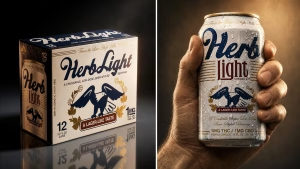
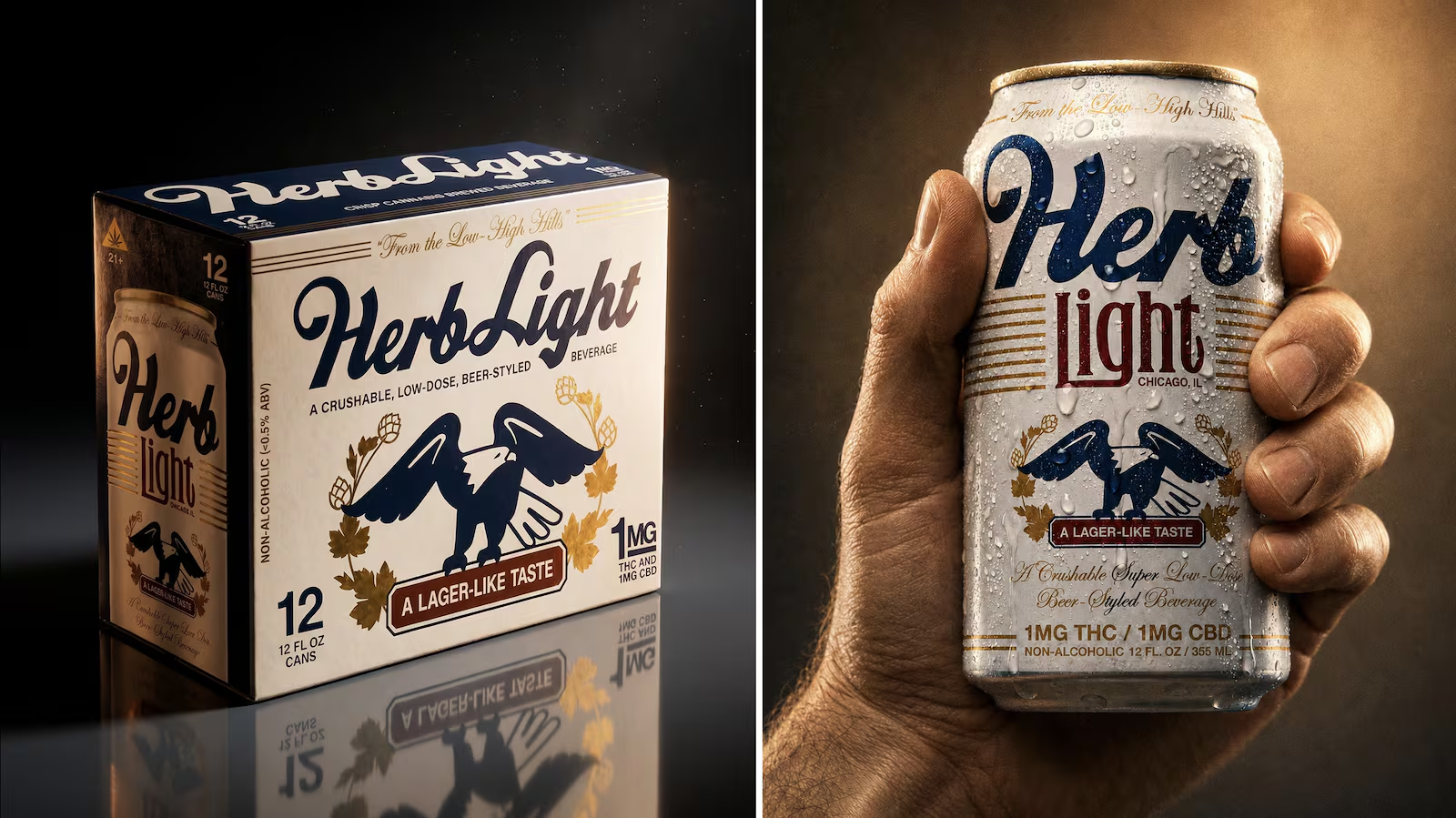
Herb Light, a new Chicago-born THC beverage, is taking an increasingly interesting route. Instead of trying to make cannabis look more like cannabis, the brand is borrowing heavily from the beer industry.
The product is a nonalcoholic, lager-style beverage containing 1 mg of hemp-derived Delta-9 THC per can. Its proposition is straightforward. Give consumers the familiar taste and social ritual of a light beer while replacing alcohol with a very low dose of THC.
That positioning puts Herb Light inside several converging beverage trends, including alcohol moderation, nonalcoholic beer, low-dose cannabis and the growing demand for products designed around social occasions rather than intoxication.
More importantly, it offers a useful case study in how cannabis beverage companies may compete as the category becomes increasingly crowded.
Why THC Brands Are Borrowing From Beer
The appeal of a beer-style THC drink is not difficult to understand.
Beer already has a powerful behavioral framework built around it. People understand when to drink it, where to drink it, how to serve it and what kinds of occasions it belongs in. The can itself communicates familiarity.
Cannabis beverages, by comparison, are still establishing many of those conventions.
That creates an opportunity for brands to borrow from a category that has spent decades teaching consumers how a beverage can become part of a social ritual.
Herb Light was developed around that premise. Its founders, Gordy Sang and Brian Siedband of Chicago creative agency Quality Meats, saw an opening between nonalcoholic beer and cannabis beverages that often emphasize stronger doses or fruit-forward flavors.
The business question is whether consumers who are reducing alcohol will want something beyond an alcohol-free beer without necessarily wanting a conventional cannabis experience.
Herb Light is betting they will.
Low Dose Is A Business Strategy
The 1 mg THC formulation is arguably the most important part of that bet.
Cannabis beverage companies have to solve a consumer education problem. For someone unfamiliar with THC drinks, a higher-dose product can introduce uncertainty around how much to consume and what the experience will be like.
A 1 mg product communicates a different proposition.
Rather than positioning the beverage around intensity, Herb Light is positioning it around sessionability and familiarity. The objective is closer to having another drink during a social occasion than consuming a product specifically to become intoxicated.
That does not mean every cannabis consumer wants such a low dose. In fact, the category contains plenty of evidence that higher-dose products have their own audience.
But the existence of a low-dose segment matters because it potentially expands the addressable market.
The customer is not necessarily replacing a cannabis product. They may be replacing a beer, cocktail or second alcoholic drink.
That distinction could be commercially significant.
The Product Has To Stand On Its Own
The beer positioning would mean little if the liquid did not deliver a credible beer experience.
Herb Light’s product development team includes Jon Schiff and brewer Jacob Sembrano, who has been associated with Cruz Blanca and Goose Island. The formulation uses carbonated water, barley, yeast and a nano-emulsified hemp extract, according to the company’s current FAQ. Herb Light describes the result as beer-flavored rather than fruity or wellness-oriented.
That is another important category signal.
Cannabis beverages do not have to develop an entirely separate drinking culture. They can compete by entering existing beverage occasions and adapting familiar formats.
Beer-style THC drinks are therefore less about novelty than they may initially appear.
They are an attempt to reduce the behavioral friction around cannabis.
Brand Identity Becomes A Competitive Advantage
Herb Light also demonstrates why branding is becoming increasingly important in cannabis beverages.
The company does not look like a conventional cannabis startup. Its packaging and advertising borrow from the visual language of American light beer, including retro references to beer advertising from the 1970s and 1980s. The strategy essentially creates an alternate history in which THC beverages existed alongside light beer.
That gives the product an identity consumers can understand without requiring extensive cannabis education.
For a crowded beverage category, that matters.
The competition is not simply between THC doses. Brands are competing for refrigerator space, retail attention, social relevance and repeat purchase.
A recognizable identity can therefore become a commercial asset.
Herb Light’s Chicago launch illustrates the strategy. The beverage is being distributed through BrightBev and has appeared at Chicago-area retail and on-premise locations, including Foxtrot Market, Beer Temple and other bars and restaurants. Industry and company sources also report online distribution into 28 states, although availability varies by market.
Cannabis Beverages Are Selling An Occasion
This is where the business case extends beyond Herb Light.
The strongest opportunity for THC beverages may not be convincing consumers to become cannabis enthusiasts. It may be giving existing beverage consumers another option for familiar occasions.
That can include a backyard gathering, a concert, a sporting event, dinner with friends or an evening at home.
The broader consumer trend has already been visible in the alcohol market. More consumers are experimenting with moderation while still participating in the rituals associated with drinking.
Herb Light’s strategy fits into that shift and connects with the broader adult-consumer trend discussed in Forget Gen Z The Cannabis Industry Is Chasing Dads.
The opportunity is not necessarily to eliminate alcohol.
It is to make the beverage category more flexible.
Regulation Could Change The Business Model
For hemp-derived THC beverage companies, however, product strategy cannot be separated from regulation.
That issue is particularly important for Herb Light.
Under Section 781 of Public Law 119-37, the federal definition of hemp is scheduled to change on November 12, 2026. The amended framework moves toward a total-THC standard and excludes final hemp-derived cannabinoid products containing more than 0.4 mg of combined total THC and certain other THC-like cannabinoids per container. The law also establishes additional exclusions concerning cannabinoids that are synthesized or manufactured outside the plant.
That creates a significant challenge for products built around more than 0.4 mg of THC per retail container.
Herb Light currently advertises 1 mg of Delta-9 THC per can. If the new federal framework applies to the product as currently formulated, its existing dosage would exceed the statutory 0.4 mg per-container threshold.
But the practical implications are not something businesses should oversimplify. The law requires additional federal guidance, including information concerning cannabinoid classifications and the definition of a container, while Congress and regulators can still affect how the market develops.
For beverage companies, that uncertainty makes formulation flexibility and regulatory planning part of the core business strategy.
Flexibility May Matter As Much As Flavor
The next generation of THC beverage companies may therefore need to operate more like adaptable consumer packaged goods businesses than conventional cannabis brands.
Products may need multiple formulations. Distribution strategies may need to vary by state. Packaging, dosage and claims may need to change as regulations evolve.
Herb Light is interesting because its business model is being tested at the intersection of several markets at once. It is a cannabis product competing for consumers who may also be shopping the beer, nonalcoholic beer and functional beverage aisles.
Its low-dose positioning is one response to that competitive landscape. Its beer-inspired identity is another.
Neither guarantees success.
But together they illustrate where the THC beverage category may be heading.
The next phase of cannabis beverages is unlikely to be defined solely by how much THC a can contains. It will be defined by whether brands can create products consumers understand, occasions they want to repeat and business models capable of surviving regulatory change.
Herb Light is an early example of that approach.
Its biggest lesson may be that the future of cannabis beverages could look surprisingly familiar. The winning brands may not ask consumers to learn an entirely new way to drink. They may simply give familiar drinking occasions a different option.