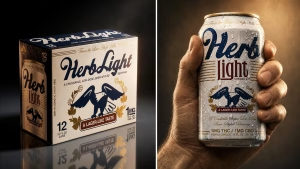

A new White House funding request has renewed debate over the future of hemp-derived cannabinoid products, with manufacturers, retailers, and industry groups urging Congress to replace broad restrictions with a comprehensive federal regulatory framework.
The hemp industry is once again at a pivotal moment as federal hemp policymakers debate how hemp-derived cannabinoid products should be regulated nationwide. While the 2018 Farm Bill established the legal foundation for hemp production, the rapid growth of finished cannabinoid products including beverages, gummies, edibles, tinctures, and vape products has exposed gaps in the regulatory system that businesses have navigated for years.
That discussion gained new momentum after the White House, as part of a supplemental funding request submitted to Congress on June 24, called for lawmakers to replace an impending federal hemp ban with a comprehensive regulatory framework. The Administration also indicated that, at a minimum, Congress should consider extending the current moratorium to provide additional time for developing permanent regulations.
The proposal has drawn support from several hemp industry organizations, including the U.S. Hemp Roundtable, which described the request as an important step toward replacing broad prohibitions with science-based oversight. Companies operating within the hemp-derived cannabinoid market, including Lifted Made, have also welcomed renewed discussions around federal regulation that emphasizes consumer protection rather than outright prohibition.
Although Congress has already enacted changes affecting federal hemp policy, lawmakers continue to debate whether portions of those provisions should be modified before they take effect. For manufacturers, retailers, distributors, and investors, the outcome could influence everything from product development and interstate commerce to compliance costs and long-term business planning.
Understanding the Current Federal Hemp Framework
The legal hemp market began with the Agricultural Improvement Act of 2018, commonly known as the 2018 Farm Bill. The legislation removed hemp from the federal hemp list of controlled substances and directed the U.S. Department of Agriculture (USDA) to establish a national regulatory program governing hemp cultivation.
USDA first implemented the Domestic Hemp Production Program through an Interim Final Rule published in October 2019 before issuing its Final Rule in January 2021. Those regulations became effective on March 22, 2021, and are codified under 7 CFR Part 990, establishing national standards for hemp production, licensing, compliance testing, harvest procedures, and reporting requirements.
Importantly, USDA’s authority is largely limited to hemp cultivation. Once compliant hemp leaves the farm, finished products intended for human or animal consumption generally fall under the jurisdiction of the U.S. Food and Drug Administration, while individual states and Tribal governments may impose additional requirements covering manufacturing, testing, packaging, labeling, retail sales, and consumer protections.
That division of authority has produced a patchwork of state regulations. A hemp-derived product that satisfies requirements in one jurisdiction may require different testing protocols, labeling, age-verification procedures, or potency limits before it can be sold elsewhere. For companies operating across multiple markets, those inconsistencies have become one of the industry’s most significant compliance challenges.
Why Federal Regulation Is Back in the Spotlight
As consumer demand for hemp-derived cannabinoid products has expanded, Congress has continued to revisit federal hemp policy.
Recent legislative changes introduced additional restrictions scheduled for future implementation, prompting widespread discussion throughout the industry about how those provisions should ultimately be applied. Supporters of a comprehensive federal framework argue that clear national standards would provide greater consistency than the current mix of federal oversight and state-by-state regulations.
The White House’s recent supplemental funding request reflects that broader conversation by encouraging Congress to replace broad restrictions with a structured regulatory system. According to the Administration’s request, lawmakers should pursue comprehensive regulation or, at minimum, extend the existing moratorium to allow additional time for crafting permanent legislation.
While the White House recommendation does not itself change federal law, it places renewed attention on congressional efforts to determine how hemp-derived cannabinoid products should be regulated moving forward.
Lifted Made Supports a Regulatory Approach
Among the companies supporting a comprehensive federal framework is Lifted Made, the parent company behind brands including Urb and Highlandia.
In response to the recent White House recommendation, Lifted Made said it supports legislation centered on responsible regulation rather than broad prohibitions. Chief Executive Officer Nicholas Warrender stated that science-based oversight, consistent manufacturing standards, transparent labeling, rigorous product testing, and effective age restrictions would better protect consumers while allowing responsible businesses to continue operating within a regulated marketplace.
Lifted Made also argues that national standards would encourage innovation by creating greater regulatory certainty for manufacturers investing in product development, research, and distribution.
Those comments represent Lifted Made’s position as an industry participant. Other stakeholders continue to advocate for varying approaches depending on their role within the broader cannabis and hemp sectors.
Industry Groups Call for Consistent Standards
Lifted Made is not alone in calling for greater regulatory clarity.
The U.S. Hemp Roundtable, one of the industry’s leading advocacy organizations, welcomed the White House recommendation, saying a comprehensive federal framework would better protect consumers while preserving opportunities for responsible businesses. The organization has consistently supported national standards that emphasize product safety, science-based regulation, age restrictions, accurate labeling, and enforcement against noncompliant operators rather than broad product bans.
Not every stakeholder agrees on the best path forward, however.
Many state-licensed cannabis operators argue that intoxicating hemp-derived products should be regulated under standards similar to those governing state cannabis markets, including licensing, testing, taxation, and product tracking requirements. Others believe existing hemp businesses should remain distinct from state cannabis programs but operate under stronger federal oversight that creates greater consistency across state lines.
Despite differing views, many industry participants agree that the current patchwork of regulations creates unnecessary uncertainty for businesses and consumers alike.
Compliance Challenges Continue to Grow
For manufacturers and retailers, regulatory complexity has become a significant business concern.
Companies selling products nationwide frequently encounter different requirements involving laboratory testing, cannabinoid disclosures, child-resistant packaging, warning statements, serving-size recommendations, marketing restrictions, and minimum purchasing ages. Products that comply with one state’s regulations may require reformulation, revised labeling, or entirely different packaging before entering another market.
These inconsistencies increase operating costs and complicate national distribution strategies. Businesses must continually monitor changing state laws while maintaining compliance across multiple jurisdictions, often requiring additional legal review, testing, and operational adjustments.
Industry advocates argue that clearer federal standards could reduce those burdens by establishing more consistent expectations while preserving state authority where appropriate.
Business Decisions Depend on Regulatory Certainty
The evolving regulatory environment is also shaping investment decisions throughout the hemp industry.
Manufacturers considering facility expansions, new product lines, or national distribution partnerships often evaluate regulatory risk alongside market demand. Uncertainty surrounding future federal requirements can delay capital investment, product launches, and long-term business planning.
Smaller hemp businesses may face particular challenges if future regulations require significant product reformulation, additional testing, or new compliance systems. Larger operators generally have greater resources to adapt, while independent manufacturers and retailers may encounter higher compliance costs relative to their size.
Supporters of federal standardization argue that predictable rules would provide businesses with greater confidence to invest in research, manufacturing, workforce development, and innovation.
Hemp Beverages Remain a Fast-Growing Category
One product category receiving significant attention is hemp-derived beverages.
Brands such as Urb and Highlandia have helped expand consumer awareness of cannabinoid-infused drinks, joining a rapidly growing segment that has attracted both established beverage companies and emerging cannabis brands.
Supporters believe beverages demonstrate how hemp-derived cannabinoids can be incorporated into regulated consumer products with standardized serving information, transparent labeling, and responsible marketing practices. At the same time, regulators continue to evaluate issues such as potency limits, age verification, packaging standards, and interstate distribution as the category expands.
How lawmakers ultimately regulate hemp beverages could influence future innovation across the broader cannabinoid marketplace.
What Comes Next for the Hemp Industry
The coming months will be critical for hemp businesses across the United States.
Congress now faces decisions that could shape how hemp-derived cannabinoid products are manufactured, distributed, marketed, and sold for years to come. While the White House has encouraged lawmakers to pursue a comprehensive regulatory framework, the final outcome will depend on congressional negotiations and any resulting legislation.
For businesses, the debate extends beyond compliance. It affects investment decisions, product development, consumer confidence, interstate commerce, and the ability to compete in an increasingly sophisticated marketplace.
As policymakers continue evaluating the future of federal hemp regulation, many operators are calling for a system that prioritizes consumer safety, consistent enforcement, reliable product standards, and clear rules that can support responsible innovation. Whether Congress ultimately adopts that approach or pursues a different regulatory path, the decisions made over the coming months are likely to define the next chapter of the legal hemp industry.
Here are some other articles related to your search:
- Why THC Beverages Are Winning Over Modern Fathers
- Highlandia Wants To Be Your Next Vacation In A Can
- Forget Gen Z The Cannabis Industry Is Chasing Dads